
First, the honest answer: nobody can guarantee the Northern Lights. Seeing them needs three things to line up on the same night: enough aurora activity, darkness, and clear skies. You can do everything right and still miss them if it is cloudy, and you can see a strong display with little planning if the sky happens to be clear and dark. Treat the aurora as a bonus on a winter trip, not the whole reason for it, and give yourself several nights to improve your chances.
This guide covers when the season runs, where to look, how to read Iceland’s official aurora forecast, whether to join a tour or go on your own, and the basics of photographing the lights. The facts come from official Icelandic and UK sources, read on 4 November 2026.
The honest answer
- The Northern Lights are never guaranteed, no matter how much you pay or plan.
- You need darkness (so not the bright summer months), a clear sky (clouds block the view), and aurora activity on the night.
- The more nights you have, and the more flexible you are about where you go, the better your odds.
- A single night or a cloudy week can mean no lights at all. Build in several nights and keep your expectations realistic.
The season
The Northern Lights season in Iceland runs roughly from September to April, because you need dark skies and Iceland’s summer nights are too bright. Within that window, there is no “best” guaranteed week; a clear, dark night with aurora activity is what matters, not the calendar date.
Darkness is on your side in deep winter: Iceland has only around 4 to 5 hours of daylight in midwinter, so there are many dark hours to watch. The trade-off is colder weather and harder driving. Shoulder months (September to October, March to April) can be milder with still-dark nights.
Where to see them
You do not need a famous viewpoint; you need to be away from bright lights with a clear view of the sky. On a strong night the aurora can even be seen from the edge of Reykjavík, but light pollution makes faint displays hard to spot, so it is worth getting out of the city.
- Just outside Reykjavík: parks, the shoreline and open ground away from street lights.
- The Golden Circle and South Coast: open countryside with dark skies; many aurora tours head this way to find a gap in the clouds.
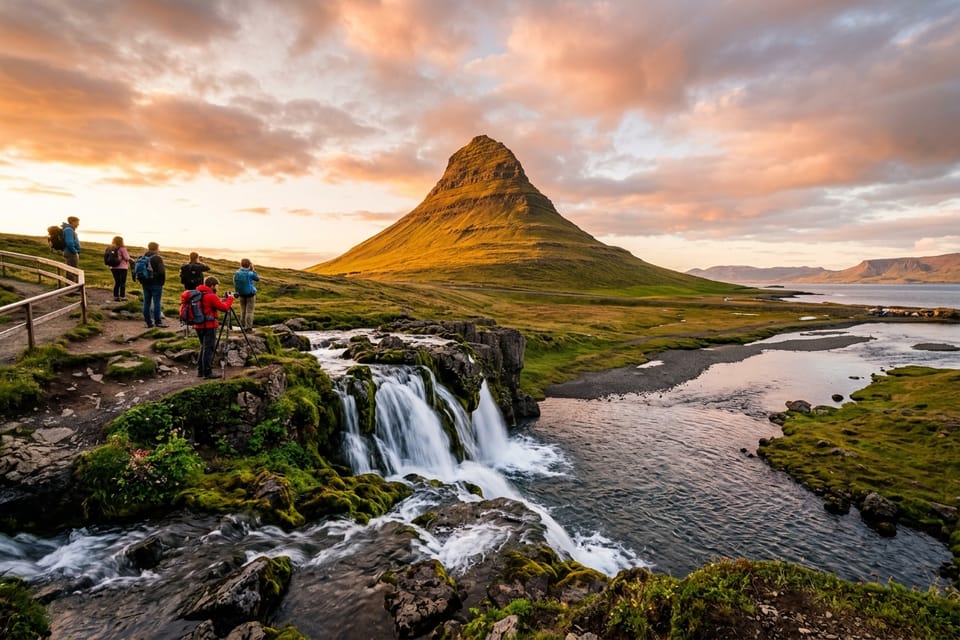
- The Snæfellsnes peninsula: dark and open, if conditions allow the drive.
Wherever you go, check the road status and safetravel.is first in winter, and never stop on the carriageway to look up — pull fully off the road in a safe place.
How to check the official forecast
Iceland’s Met Office publishes a free aurora forecast that combines expected aurora activity with cloud cover: en.vedur.is aurora forecast.
Read it together, not in isolation:
- Cloud cover on the map shows where the sky is expected to be clear. You want a gap in the clouds above you, so sometimes it is worth driving an hour to reach clearer skies.
- Aurora activity is shown on a simple scale. Higher activity improves your chances, but even a modest level can be visible if the sky is dark and clear.
Check it the same day and again in the evening, because both the clouds and the activity forecast change. Pair it with the general weather forecast at en.vedur.is.
Tours vs going on your own
- Guided aurora tours from Reykjavík do the chasing for you: the guide watches the forecast and drives toward a clear patch of sky, and many operators let you re-join another night free of charge if the tour sees nothing. This removes the winter-driving worry and is a good choice if you are not renting a car.
- On your own gives you freedom to wait as long as you like at a dark spot, but it means driving at night in winter. Read our Iceland itinerary guide for the driving and road-safety basics, keep an eye on safetravel.is, and only go if you are comfortable with the conditions.
You can book aurora tours through our partners; you book and pay directly with the operator, not with Voyfaro.
Photography basics
A phone on night mode can capture the lights, but a few basics help whatever camera you use:
- Steady the camera. Use a small tripod, or rest it on something solid, because exposures are long.
- Use a long exposure. A few seconds is a common starting point; longer for faint lights, shorter for bright, fast-moving ones.
- Open the aperture and raise the ISO so the sensor gathers more light, then adjust once you see a test shot.
- Focus manually toward infinity (a distant light or the moon helps), because autofocus struggles in the dark.
- Dress for standing still in the cold, and bring a spare battery — cold drains them fast.
What else to do on a winter trip
The aurora is a night-time bonus; fill the short daylight hours with the rest of Iceland. See our full Iceland itinerary for 5 or 7 days for the Golden Circle, the South Coast waterfalls and black beach, the Jökulsárlón glacier lagoon and the geothermal pools that are a highlight of any winter day.
Safety and conditions
- Winter driving and weather change fast. Check en.vedur.is, the road status and safetravel.is daily.
- Volcanic activity. GOV.UK reports ongoing eruptions on the Reykjanes peninsula near Grindavík, and says Reykjavík and Keflavík International Airport have not been affected. Follow GOV.UK travel advice for Iceland.
Staying connected
- Phone and data: a travel eSIM keeps you online to check the forecast on the move. See our eSIM finder and eSIM for Europe.
- Plugs: types C and F, 230V, 50Hz. See our plug adapter tool.
- More on the region: Europe and Schengen travel guides.
FAQ
Can you guarantee seeing the Northern Lights in Iceland?
No. Nobody can. You need aurora activity, darkness and a clear sky on the same night, and even then it can be cloudy. Give yourself several nights and keep your expectations realistic.
When can you see the Northern Lights in Iceland?
Roughly September to April, when the nights are dark enough. There is no guaranteed “best” week; a clear, dark night with aurora activity is what counts.
Where is the best place to see them?
Anywhere away from bright lights with a clear view of the sky. On a strong night they can be seen near Reykjavík, but darker countryside improves your chances.
How do I check if the lights will be out?
Use the Icelandic Met Office aurora forecast at en.vedur.is, which shows both cloud cover and expected aurora activity. Check it in the evening, as it changes.
Should I book a tour or drive myself?
Tours do the chasing and avoid night driving, and many let you re-join free if the tour sees nothing. Self-drive gives more freedom but means driving in winter conditions.
Sources
Official pages we checked on 4 November 2026:
- Icelandic Met Office, aurora forecast and en.vedur.is (aurora activity, cloud cover, weather)
- Icelandic Road and Coastal Administration, road.is / umferdin.is (road status)
- SafeTravel, safetravel.is (safety and conditions)
- GOV.UK, Iceland travel advice (volcanic activity)