
Iceland is a short flight from much of Europe, and a week is enough to see a lot of it: the geysers and waterfalls of the Golden Circle, the black beaches and glaciers of the South Coast, and the quieter Snæfellsnes peninsula. This guide gives you a day-by-day Iceland itinerary for 5 or 7 days from a Reykjavík base, how to get around by self-drive or guided day tour, and what to check before you book.
The day plans are our editorial picks. The facts (entry rules, roads, weather, prices) come from official Icelandic and UK sources, read on 4 November 2026. Where an official page gave no figure, we give none.
Iceland in 5 or 7 days: the quick answer
- 5 days: base in or near Reykjavík. Day 1 the city, day 2 the Golden Circle, day 3 the South Coast to the waterfalls and black beach, day 4 a longer South Coast day or a tour of your choice, day 5 a relaxed morning and your flight.
- 7 days: the same first days, plus a day out to the Jökulsárlón glacier lagoon on the South Coast and a day on the Snæfellsnes peninsula.
- Summer or winter? Summer (around June to August) brings mild weather and very long daylight, and opens the highland F-roads. Winter (around November to March) is cold and dark but is the season for the Northern Lights and snowy landscapes, with harder driving.
- Before you book: check the entry rules for your passport on the official site, the weather forecast and the live road status, and the current GOV.UK travel advice. Iceland is in the Schengen area.
Before you plan: what to check
Entry rules
Iceland is part of the Schengen area. Many nationalities, including UK citizens, can visit visa-free for up to 90 days in any 180-day period; others need a Schengen visa. Rather than a country-by-country list that can go out of date, check your own case on the official Icelandic government site:
This is general information, not legal or immigration advice, and the border authorities make the decision. If you hold a UK passport, GOV.UK says it should have been issued less than 10 years before the day you arrive and be valid for at least 3 months after the day you plan to leave the Schengen area (GOV.UK: Iceland entry requirements).
Two EU border systems are worth knowing about:
- EES (Entry/Exit System). The EU is rolling out a new system that records a biometric (facial image and fingerprints) on your first entry instead of stamping your passport. It is free, and the record is kept for 3 years. See the official page: EES on travel-europe.europa.eu.
- ETIAS. A planned travel authorisation for visa-exempt visitors. It is not in operation yet, and the EU has not confirmed a start date. We do not publish a date. See the official page: ETIAS on travel-europe.europa.eu.
Weather and daylight
Iceland’s weather changes fast in any season, so plan around the forecast rather than fixed dates. The official forecaster is the Icelandic Met Office at en.vedur.is.
Daylight swings a long way through the year: from only around 4 to 5 hours in midwinter to more than 20 hours around midsummer. In winter, plan sightseeing for the few bright hours and keep drives short; in summer you can keep going late into the evening.
Driving and roads
- The Ring Road (Route 1) circles the island and is paved. It is open year-round in principle, but sections can close in winter storms. Check the live status before and during any drive at road.is / umferdin.is.
- Highland F-roads are gravel mountain routes that are usually closed from around mid-September until some time in June or July; the exact opening dates vary by road and year, so we do not publish fixed dates. They require a 4x4, driving off-road is forbidden, and insurance usually does not cover river crossings.
- Winter driving means rapid changes in conditions. Keep your dipped headlights on (Iceland requires headlights on at all times, day and night), and note that the drink-drive limit is low. Read the official safety guidance at safetravel.is alongside the road status and GOV.UK.
Car hire and budget
Self-drive gives you the most freedom; guided day tours remove the driving and the winter-road worry. Car-hire companies set their own terms, including the minimum age and young-driver rules, so check the rental company’s own conditions before you book. Iceland is an expensive country, and it is largely cashless: cards (including contactless) are accepted almost everywhere, so you rarely need cash. The currency is the Icelandic króna (ISK); our currency converter shows your own currency. Plugs are types C and F, 230V, 50Hz; see our plug adapter tool.
Day-by-day: the 5-day plan
Day 1: Reykjavík
Walk the compact centre: the Hallgrímskirkja church and its tower view, the Sun Voyager sculpture on the waterfront, the Harpa concert hall and the old harbour. Pick up a local SIM or set up a travel eSIM for data on the road (see our eSIM finder), and buy any warm and waterproof layers you are missing.
Day 2: the Golden Circle
The classic loop from Reykjavík:
- Þingvellir National Park, where the North American and Eurasian plates pull apart, and the site of Iceland’s old open-air parliament. There is no park entrance fee; the national park charges a parking service fee of 1,000 ISK for a standard passenger car (Category B, 5 seats or fewer), which you pay online or at a machine. Confirm the current fee on the official page: Þingvellir parking.
- Geysir and Strokkur, where Strokkur erupts every few minutes. It is free, with no fee.
- Gullfoss, a powerful two-step waterfall. It is free to visit, with no fee.
Day 3: the South Coast
Head east on the Ring Road to the waterfalls Seljalandsfoss (you can walk behind it) and Skógafoss, then the black-sand beach at Reynisfjara near Vík. Reynisfjara has dangerous “sneaker” waves: obey the warning signs, never turn your back on the sea and keep well back from the water.
Day 4: a longer South Coast day or a tour
Go further east to the Sólheimajökull glacier tongue for a guided glacier walk with an operator that provides the gear, or choose an activity you prefer (a South Coast tour, horse riding, or a lava-and-caves day). In winter this can also be a Northern Lights night (see below).
Day 5: a relaxed morning
Keep the last day light in case the weather or roads change your plans: a swim at a local geothermal pool, last-minute shopping in Reykjavík, and the drive back to Keflavík for your flight. The airport is about 45 minutes from the city.
Day-by-day: the 7-day plan
Keep days 1 to 4 above, then add:
Day 5: Jökulsárlón glacier lagoon
Drive further along the South Coast (Route 1) to the Jökulsárlón glacier lagoon, where icebergs drift toward the sea, and the nearby Diamond Beach where they wash up on black sand. The lagoon is free to view from the shore. Boat tours on the lagoon run seasonally, roughly May to October depending on the operator and conditions, with no fixed dates, so check the operator and the road status before a long day out. This is a long round trip from Reykjavík; many travellers stay a night on the South Coast to break it up.
Day 6: the Snæfellsnes peninsula
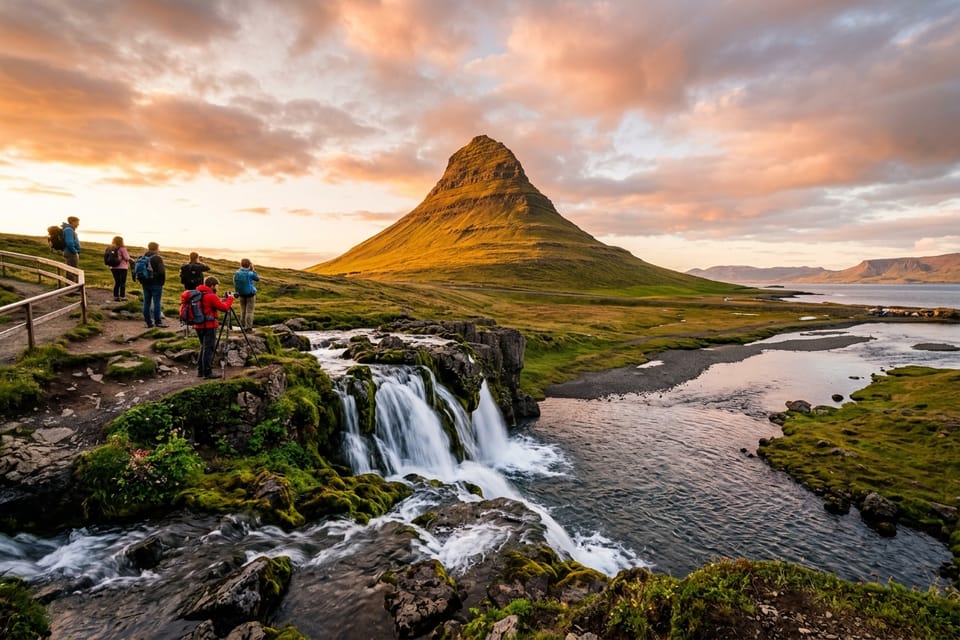
West of Reykjavík, Snæfellsnes packs a lot into one peninsula: the Kirkjufell mountain near Grundarfjörður, black-pebble coves, small fishing villages and the Snæfellsjökull glacier. It is reachable year-round, but take winter conditions seriously and check safetravel.is and the road status.
Day 7: Reykjavík and your flight
A relaxed last day as on the 5-day plan.
Getting around: self-drive vs guided day tours
- Self-drive suits travellers who want to stop where they like and keep their own pace. In summer it is straightforward on the Ring Road; in winter, build in extra time, watch the forecast and road status, and be ready to change plans. Highland F-roads need a 4x4 and experience.
- Guided day tours from Reykjavík cover the Golden Circle, South Coast, glacier lagoon and more without you driving, which many people prefer in the dark winter months. You can book tours and activities through our partners; you book and pay with the operator, not with Voyfaro.
Iceland by traveller type
Families
Short driving days, the geothermal pools (a daily highlight for children), and guided tours that handle the roads. Keep well back from the sea at Reynisfjara, and dress everyone for sudden weather.
Couples
Reykjavík’s cafés and pools, a glacier walk, the glacier lagoon at golden hour, and in winter a Northern Lights night away from the city lights.
Solo travellers
Guided small-group day tours are an easy, social way to see the sights without driving in winter. Tell someone your plan, and check safetravel.is before any self-drive.
Students and budget travellers
Iceland is expensive, so cook some meals, share a hire car, use the free sights (Golden Circle waterfalls, the lagoon viewpoint, city walks) and the cheap geothermal pools, and travel in the shoulder seasons.
Northern Lights: a quick note
If you travel between roughly September and April, you have a chance of seeing the Northern Lights on a clear, dark night with enough aurora activity. They are never guaranteed. Our dedicated guide explains the season, where to go and how to read the official forecast: Northern Lights in Iceland.
Safety and current conditions
- Volcanic activity. GOV.UK reports ongoing volcanic eruptions on the Reykjanes peninsula near the town of Grindavík, which have continued since December 2023. GOV.UK says Reykjavík and Keflavík International Airport have not been affected. Follow GOV.UK travel advice for Iceland and safetravel.is for the latest.
- The Blue Lagoon sits near Grindavík, and has closed at short notice during periods of volcanic activity. We do not state whether it is open; check the official site bluelagoon.com and safetravel.is close to your visit, and have a backup plan.
- Weather and roads can change fast. Check en.vedur.is and road.is / umferdin.is daily, and read safetravel.is.
Money and staying connected
- Currency: the Icelandic króna (ISK). Iceland is largely cashless, so cards work almost everywhere. Our currency converter shows your own currency.
- Phone: buy a local SIM or use a travel eSIM. See our eSIM finder and eSIM for Europe.
- Plugs: types C and F, 230V, 50Hz. See our plug adapter tool.
- Insurance: if you need a Schengen visa, read our Schengen travel insurance guide. If a flight is delayed or cancelled, see your EU261/UK261 flight-delay rights.
- More on the region: Europe and Schengen travel guides.
Common mistakes
- Underestimating winter driving. Conditions change fast; check the road status and forecast every day, and keep drives short in the few winter daylight hours.
- Driving onto an F-road without a 4x4. Highland roads need a 4x4 and are usually closed much of the year; off-road driving is forbidden.
- Turning your back on the sea at Reynisfjara. The sneaker waves there are dangerous. Obey the signs.
- Expecting to pay cash. Iceland is largely cashless; bring a card that works abroad.
- Treating the Northern Lights as a sure thing. They are never guaranteed.
FAQ
Is 5 days enough for Iceland?
Yes, for Reykjavík, the Golden Circle and the South Coast at a comfortable pace. With 7 days you can add the Jökulsárlón glacier lagoon and the Snæfellsnes peninsula.
Do I need a visa for Iceland?
Iceland is in the Schengen area. Many nationalities, including UK citizens, can visit visa-free for up to 90 days in any 180-day period; others need a Schengen visa. Check your own case on the official checker at island.is. The border authorities decide.
When is the best time to visit Iceland?
Summer (around June to August) for mild weather, very long daylight and the highland roads; winter (around November to March) for the Northern Lights and snow, with harder driving and short days.
Should I self-drive or take tours?
Self-drive gives the most freedom and works well in summer. In the dark winter months many travellers prefer guided day tours so they do not have to drive.
Is there a fee for the Golden Circle?
Geysir/Strokkur and Gullfoss are free. Þingvellir has no entrance fee but charges a parking service fee of 1,000 ISK for a standard passenger car; confirm it on the official page.
Is Iceland safe right now?
GOV.UK reports ongoing eruptions on the Reykjanes peninsula near Grindavík but says Reykjavík and Keflavík Airport are not affected. Read GOV.UK travel advice and safetravel.is before and during your trip.
Sources
Official pages we checked on 4 November 2026:
- island.is, Do you need a visa? and Entry requirements to Iceland
- GOV.UK, Iceland travel advice and entry requirements (passport validity, volcanic activity)
- European Commission, EES and ETIAS
- Icelandic Met Office, en.vedur.is (weather)
- Icelandic Road and Coastal Administration, road.is / umferdin.is (road status)
- SafeTravel, safetravel.is (safety and conditions)
- Þingvellir National Park, parking service (1,000 ISK parking, no entrance fee)
- Blue Lagoon, bluelagoon.com